IPÊ
Texto: João Geraldo Kuhlmann
Pintura: J. B. de Paula Fonseca


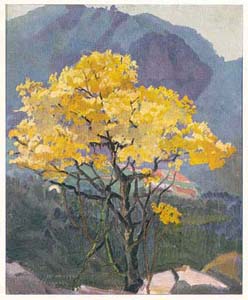
TECOMA LONGIFLORA Bur. et K. Sch.
(Bignoniaceae)

Nome vulgar: “IPÊ AMARELO”

Observações: Habita as encostas das montanhas do Rio de Janeiro, - (Serra da Estrêla e Serra dos Orgãos).

Floração: Como no ipê roxo, a floração se processa de baixo para cima: as primeiras fôlhas, aparecem nos galhos mais proximos do sólo, para, paulatinamente, ir galgando até o ápice da copa. Quando a floração está em pleno desabrochar não se nota uma só folha na arvore. As flôres são de côr amarelo-brilhante. Floresce nos mêses de Julho a Agosto.

Its habitat is on the mountains of Rio de Janeiro: (Serra da Estrela and Serra dos Orgãos).

As it is the case with “ipê roxo”, the first flowers appear on the branches nearest the ground and subsequently on the higher branches. When flowering is at its full development, there are no leaves left on the tree. Flowers are of a brilliant yellow color. Flowers in July and August.
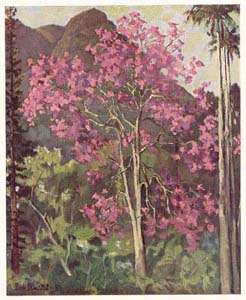
TECOMA HEPTAPHYLLA (Vell.) Mart.
(Bignoniaceae)

Nome vulgar: “IPÊ ROXO”

Observações: Árvore de excepcional apresentação decorativa, tanto no estado pre-floral como no florífero. Presta-se para a arborisação principalmente das grandes avenidas, parques e jardins. Ocorre no Distrito Federal, São Paulo, Minas Gerais, Espirito Santo, etc.

Floração: Começam a desabrochar as flôres nos galhos que deixaram cair as primeiras fôlhas, de baixo para cima; em poucos dias a arvore despe-se das fôlhas e cobre-se de flôres. No apogeu da floração, permanece por uns 15 dias. Depois, dá-se o inverno, caem, dos galhos de baixo, as primeiras flôres, para dar lugar ás folhas novas, e em poucos dias desaparecem todas as flôres, cobrindo-se a arvore inteiramente de fôlhas verdes. Floresce desde 4 anos de idade nos mêses de Junho a Agosto.

A tree of exceptionally decorative appearance, before and during the flowering season.
Lends itself to the decoration of long avenues, also parks and gardens. Found in the Federal District, States of Rio de Janeiro, Minas Gerais, Espirito Santo, etc.

It is very interesting to observe the flowering process. The flowers begin to appear first on the lower branches, which also shed their leaves first. This continues upward and in a few days the tree has lost its leaves and is covered with flowers. The peak of the inflorescence, which is abundant and beautiful, lasts for about 15 days. Later the inverse happens: the first flowers fall from the lower branches in order to give place to the new leaves, and in a few days all flowers have disappeared and the tree is entirely covered with green leaves.

It flowers from the fourth year on, in June, July and August.

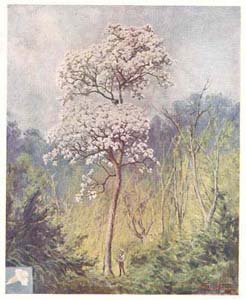
TECOMA ODONTODISCUS Bur. et K. Sch.
(Bignoniaceae)

Nome vulgar: “IPÊ BRANCO”

Observações: Ocorre no Distrito Federal, Rio de Janeiro, Minas Gerais. Presta-se para formação de grupos em parques e jardins.

Floração: Floresce nos mêses de Julho, Agosto, Setembro e Outubro. Ao cobrir-se de flôres – de lindas flôres alvas, despe-se – como quasi todos os ipês – inteiramente de folhas.

Found in the Federal District, Rio de Janeiro, Minas Gerais. Suitable for the formation of groups in parks and gardens.

Its beautiful white flowers appear in July, August, September and October. The tree sheds its leaves, at the flowering season, as do most of the “ipês”.

Págs. 1

[Álbuns Florísticos]